


ARMY DAY: THE DISCIPLINE THAT HOLDS THE REPUBLIC TOGETHER

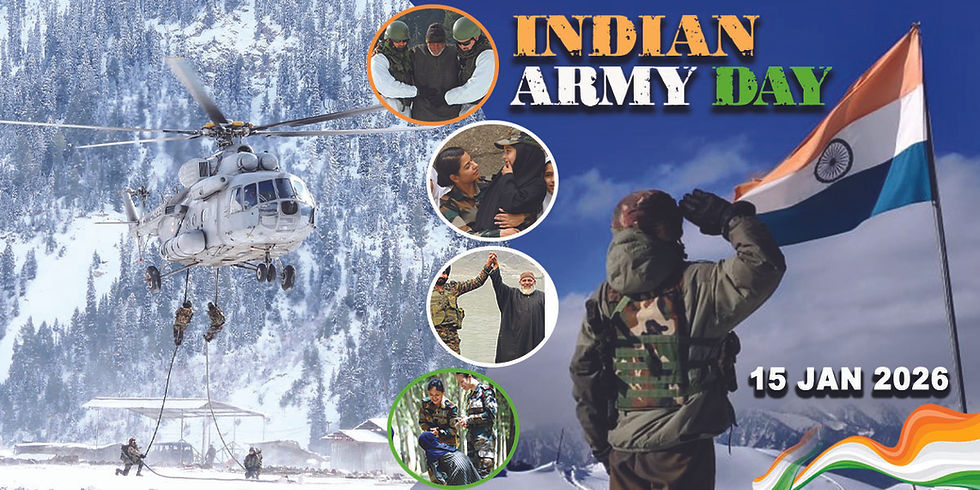
Army Day is often reduced to a ritual—parades, platitudes and predictable praise. Yet the reality it commemorates is far less comfortable. On 15 January, when India marks the transfer of military command to Indian leadership in 1949, the nation is not merely observing an anniversary; it is confronting an enduring truth: the Indian Republic survives because a disciplined force stands between constitutional order and chaos.
The Indian Army is not a symbolic institution. It is a functional necessity. In a volatile region, with unresolved borders and persistent internal security challenges, the idea that peace is natural or permanent is a dangerous illusion. Army Day exists to puncture that illusion and remind civilians that stability is not accidental—it is enforced, maintained and paid for.
India’s security threats today are not limited to conventional warfare. They include terrorism sustained by external sponsorship, hybrid conflict that weaponizes misinformation and internal radicalization that seeks to delegitimize the state itself. The Army is deployed in this grey zone where restraint is demanded even when provocation is constant. Soldiers are expected to uphold constitutional values while operating under conditions where those very values are tested daily.
What makes the Indian Army ideologically distinct is its refusal to become ideological. It does not define enemies by identity, faith, or region. It responds to threats, not narratives. In an era where politics increasingly seeks spectacle and polarization, the Army’s professionalism—apolitical, hierarchical, rule-bound—stands in sharp contrast. This discipline is not incidental; it is the bedrock of democratic control over force.
Yet, Army Day also exposes a national contradiction. Civil society frequently invokes the Army in rhetoric while distancing itself from the realities of soldiering. Slogans are easy. Structural support is harder. The soldier’s life—marked by uncertainty, repeated postings, family separation and psychological strain—rarely features in policy debates except after crisis or casualty. This selective attention amounts to moral convenience.
The Army’s role in internal security operations has been especially contentious, often framed through ideological lenses rather than operational realities. Criticism is not illegitimate in a democracy, but abstraction is dangerous. Those who debate security from studios and seminars are insulated from consequences. Those who execute policy on the ground are not. Army Day forces an uncomfortable recognition: decisions made far from the front lines are implemented by young men and women with irreversible stakes.
Beyond conflict, the Indian Army has repeatedly acted as the state’s final institutional reserve. When civil administration collapses under natural disasters or emergencies, it is the Army that restores order, delivers aid and reassures citizens. This recurring dependence raises a serious question: is the Army merely a military force, or has it become the default solution to governance failures? Army Day should prompt reflection not only on military strength, but on civilian institutional capacity.
There is also the issue of politicization by appropriation. The Army does not speak for itself; others speak for it—often selectively. Dragging the institution into partisan narratives corrodes its credibility and endangers its neutrality. Respect for the Army does not mean uncritical glorification, nor does it permit ideological capture. The line between honouring service and exploiting sacrifice must not be blurred.
As India projects itself as a rising power, the Army’s responsibilities will only expand—deterrence, diplomacy, peacekeeping and strategic signalling. But no army, however professional, can compensate for a society unwilling to confront its own responsibilities. Civil-military trust is a two-way contract: soldiers commit to the Constitution; civilians must commit to informed engagement, responsible discourse and sustained support.
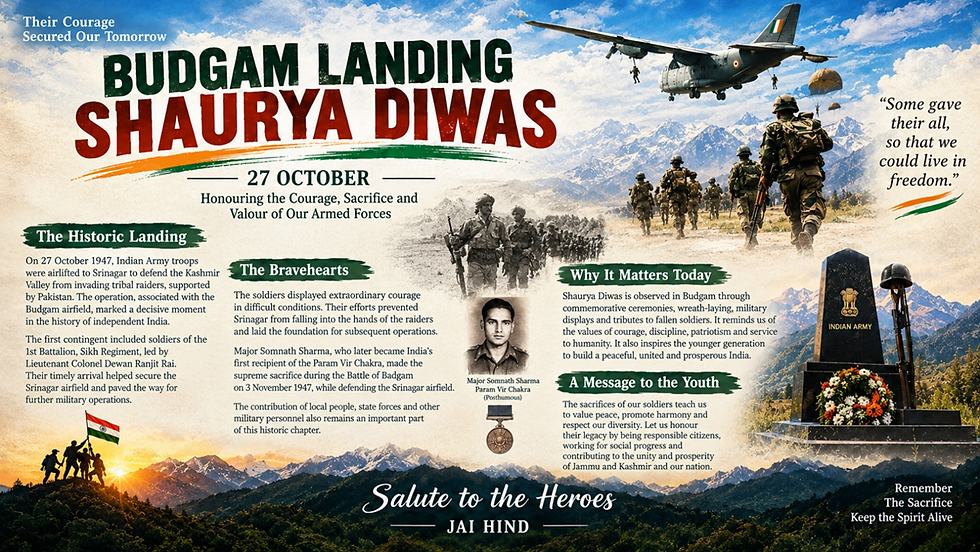
Army Day, therefore, is not a celebration of force. It is a reminder of restraint backed by readiness. It is a recognition that rights endure because duties are fulfilled—often silently, often thanklessly. The Indian Army does not ask to be mythologized. It asks to be understood. Hero of Kashmir, Heroes of Kashmir
On 15 January, the most meaningful tribute is not applause, but clarity: clarity about threats, clarity about responsibilities and clarity about the cost of preserving a Republic in an unstable world. Anything less reduces Army Day to ceremony—and the Army deserves better than that.


Comments